
Behind the Capitularia Project team lie eventful days filled with intensive research, international exchange and valuable networking. We look back on a busy trip to the Eternal City, as well as our participation in the latest network meeting of the North Rhine-Westphalian Academy of Sciences and Arts (AWK NRW) in the state capital. Two stops that demonstrate in different ways just how fruitful the combination of traditional manuscript work and digital methods is.
Stop 1: Rome – From the BAV Reading Room to the DARIAH Annual Event
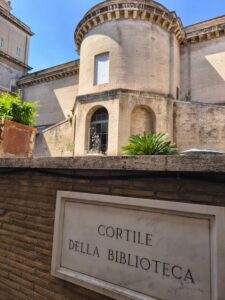
From 24 to 29 May 2026, ‘we’ (represented by Daniela Schulz) found ourselves in Rome. The first two days were devoted to the classic, analogue core work of our project: the examination of original manuscripts. In the venerable halls of the Vatican Library (Biblioteca Apostolica Vaticana, BAV), we investigated the manuscripts Pal. lat. 582, Pal. lat. 289 and Vat. lat. 4982.
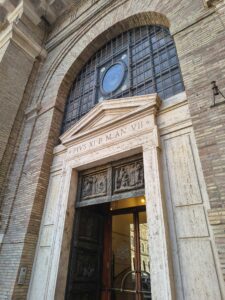
The aim was to clarify text passages and corrections that could not be deciphered from the digitised images. Among other tools, a UV lamp was used. The ultraviolet light helped to read (at least in part) isolated passages that had been erased and were long since invisible to the naked eye. Moments like these demonstrate once again that digital scans can never fully replace working directly with the codex.
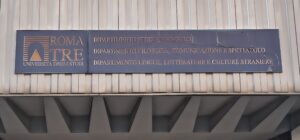
After two days of intensive work at the BAV, we moved straight from manuscript analysis into the world of digital humanities. The DARIAH Annual Event 2026 was on the agenda at Roma Tre University. This year’s event was held under the theme “Digital Arts and Humanities With and For Society: Building Infrastructures of Engagement”. On Thursday, we had the opportunity to give a talk entitled “Making Medieval Legal Heritage Accessible: Bibliotheca legum and Capitularia as Cooperative Digital Projects” at a well-attended session with around 30 participants.
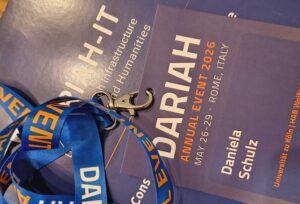
In the presentation, we traced how the two projects Capitularia and Bibliotheca legum (BL), which have developed very differently historically, successfully create synergies. Today, both projects are intertwined to make the secular law of the early Middle Ages accessible across platforms and in a networked manner. A key factor in this is our cooperation within the Databases of Early Latin Manuscripts (DELM) network. Through the DELM Lookup Service, we easily link scattered data records based on Bernhard Bischoff’s “Katalog” and the “Codices Latini Antiquiores” (CLA). Supplemented by standardised identifiers from the German Manuscript Portal, we ensure that our TEI-XML data remains future-proof and interoperable.1
We were particularly pleased with the feedback received during the lively Q&A session at the end: the community strongly encouraged us to continue our efforts towards statification of the project website. Apart from our own contribution, the conference offered excellent opportunities to exchange ideas with colleagues from international DH projects and to make new contacts.
Stop 2: Düsseldorf – SciComm and AI in the Academies Programme
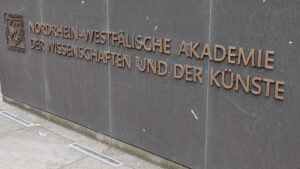
Not soon after Daniela’s return from Rome, the whole team set off for Düsseldorf on Wednesday, 3 June 2026! The AWK NRW had invited us to the 2nd networking meeting. Such meetings are a good opportunity to deepen contacts with other long-term research projects, discuss current developments and, in an informal atmosphere, discover new points of contact for collaboration within the Academies Programme.
The morning was devoted entirely to presentations by projects that have recently joined the programme. In the afternoon, the programme split into two parallel, highly topical workshops: “Strategisch Wirkung entfalten: Impact und Transfer”, focusing on science communication, and “Digitalität im Akademienprogramm: KI und Verantwortung”, organised by colleagues from the CCeH.
To gain as much as possible from the workshops for the project, our team split up. At the AI workshop, we were not merely present as listeners, but actively participated in the debate with our own contribution on the topic “AI as part of the future editorial workflow in Capitularia?”. This addressed highly relevant questions: Where can artificial intelligence provide meaningful support, and where does the line lie with regard to (editorial) responsibility? The discussion showed that the digital humanities are facing enormous but immensely exciting upheavals in this area, and that guidance is needed to make informed decisions regarding the use of AI tools.
Conclusion
Whether using a UV lamp in the dimly lit manuscript reading room in Rome or engaging in theoretical debate on science communication and AI workflows in Düsseldorf: there are many paths to knowledge. For us, the past few days have once again demonstrated that progress in the field of digital cultural heritage can only be achieved through a combination of solid philological work and strong, cross-project collaboration.
[1] Read more on that topic in the blogpost From the engine room #1: Networking as added value. Capitularia between DELM, NFDI and the Academies’ programme. The slides will be published soonish on Zenodo.↑