
The fates of books can rarely be reconstructed without gaps, and yet the biography of a single object often offers insights into many areas, such as the history of scholarship, of institutions and of collections. The Codex Weissenburgensis 97 is one of the oldest textual witnesses of Salic law. For the Capitularia project it is relevant as a witness for the capitularies Capitula legi Salicae addita and Pactus pro tenore pacis [siglum: W7], and it is a fairly typical example in this respect. The occasion for presenting it here is the publication of the two-volume Die Herzog August Bibliothek. Eine Sammlungsgeschichte (Wolfenbütteler Forschungen 176, Wiesbaden 2026), edited by Sven Limbeck, Volker Bauer, Peter Burschel, Petra Feuerstein-Herz, Johannes Mangei and Hole Rößler. In it, the Codex Weissenburgensis 97 is examined as an “object of collection and research” (“Sammlungs- und Forschungsobjekt”, pp. 431–443). The chapter traces the history of the manuscript above all through materials from the Wolfenbüttel library archive, most of which have not yet been recognized by research. This post briefly summarises some aspects of the chapter and aims to encourage readers to engage with the Sammlungsgeschichte as a whole.
In brief: The Manuscript
On the basis of its content (above all the list of rulers) and of palaeographical criteria, scholarship unanimously dates the manuscript to the second half of the 8th century. Proposed places of origin are northern or eastern France (Butzmann, following Bischoff), Burgundy (Lowe) and Fleury (Mostert). A comprehensive study of the Fleury scriptorium remains a desideratum, so this attribution is not uncontested. However, Stefanie Westphal, who in the recently published “Katalog der illuminierten Handschriften” (catalogue of illuminated manuscripts) described the decorated manuscripts of the 6th to 11th centuries held by the Herzog August Bibliothek, supports the attribution from an art-historical perspective on account of the initials decorated with animal motifs and interlace.
It is a small-format legal miscellany of 86 folios (numbered 1–8, 10–87). It combines Germanic and Roman law:
- a formula securitatis (now barely legible) (fol. 1r)
- the Lex Salica in the A version (fols. 1v–37v), followed by two capitularies, the epilogue and the list of kings
- a short parody of the Lex (fol. 37v), transmitted only here
- the so-called Epitome Guelferbytana (fols. 37v–87r), an abridged adaptation of the Visigothic Roman law, transmitted only in this codex and in a peculiar form
- a scribe’s lament (fol. 87v), whose legibility has been severely impaired by oak-gall ink treatment.
Its scribe is known by name from the colophon: an “Agambertus”, who cannot be identified more closely today and who wrote in pre-Caroline minuscule. There are no traces of medieval reception, but later users did leave their marks in the manuscript here and there.
A collection that never existed
The manuscript came to Wolfenbüttel in 1689 under the aegis of Duke Anton Ulrich, as part of the “Weissenburg manuscripts”, which Heinrich Julius von Blum had by then been offering for sale for some years. Von Blum’s accounts of their dramatic rescue, given in letters, differ considerably depending on the addressee. In one, von Blum acquires the codices in Mainz on the way to the Frankfurt fair; elsewhere a gift from the Elector of Mainz is mentioned. It seems likely that the story was embellished as much as possible to promote the sale, especially as the sale only came about years later and at a much lower price than originally demanded.
Like many other manuscripts of the so-called Weissenburgenses, Cod. 97 bears no visible marks of the Weissenburg monastic library, and the surviving medieval book lists of the monastery do not record any leges manuscripts either. In fact, only about two thirds of today’s Weissenburgenses originate from Weissenburg. The acquisition thus created a collection context that originally did not exist, whereas Otto von Heinemann (Head Librarian from 1868 to 1904) still assumed a coherent complex.
On the desks of scholars
As the loan and user registers of what is now the Herzog August Bibliothek confirm, the codex was lent out at least 17 times between 1704 and 1915, mostly to the nearer surroundings of Wolfenbüttel, but also to Berlin and Leipzig. In addition, about 55 consultations in the reading room are documented since 1899.
- Johann Georg Eckhart drew Leibniz’s attention to the manuscript in a letter in 1703. Leibniz borrowed it on 15 February 1704. Eckhart himself borrowed it in 1718 and in 1720 presented the first edition of the “Wolfenbüttel” Lex Salica.
- Franz Carl Conradi was one of the few early scholars interested in the Roman-law Epitome. The registers document his loan from 1734 until about 1738/39, so the loan period amounted to some five years.
- Georg Heinrich Pertz kept the codex from 1830 to 1840 and, besides the edition of the capitularies, published a description in the Archiv der Gesellschaft für ältere deutsche Geschichtskunde (1839).
- The manuscript was sent twice to Gustav Hänel in Leipzig. He used it for his still authoritative edition of the Lex Romana Visigothorum (1849), which also contains a very detailed description of the Wolfenbüttel codex.
- Karl August Eckhardt consulted it in the reading room for his edition of the Lex Salica (1962), as a user slip inserted in the codex shows.
The scholars’ judgements were by no means unanimous. Less well known is a “black spot” in the manuscripts history: for about ten years it factually belonged to the Parisian Bibliothèque Impériale. It was among the more than 300 manuscripts requisitioned in 1806, most of which returned to Wolfenbüttel only after about ten years. To what extent it was used by researchers in Paris cannot be determined without access to the Paris user records. The stamp of the Paris library, still visible beneath the Wolfenbüttel library stamp, bears witness to this episode to this day.
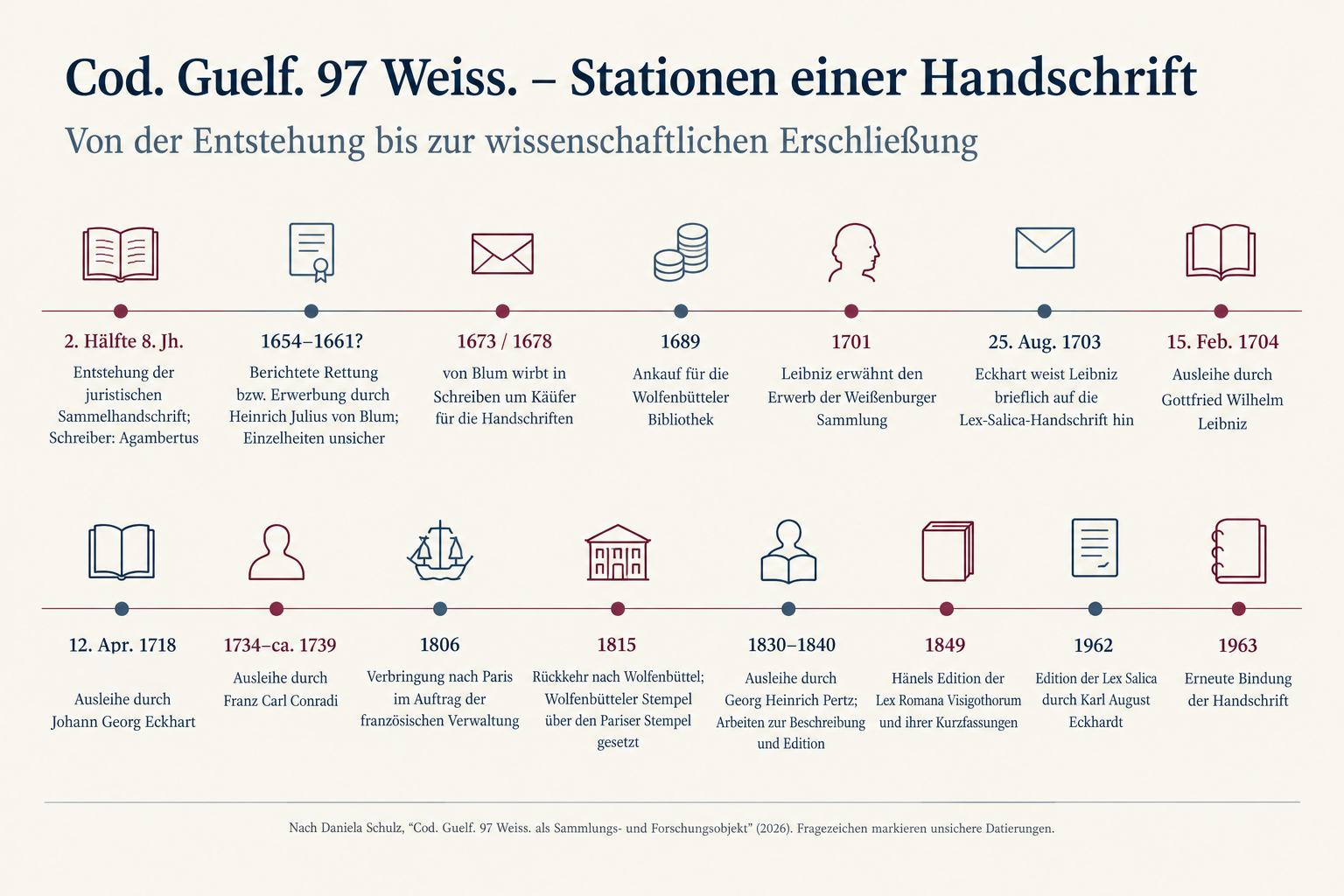
(Zeitleiste erstellt mit der Hilfe von chatGPT)
Manuscript transmission as ongoing research history
The chapter shows what intensive engagement with a single object can achieve, but also where its limits lie: despite all available sources, numerous gaps remain. That scholars in earlier times were able to work for years with precious manuscripts at their own desks is hardly imaginable today.
The history of Cod. Guelf. 97 Weiss. makes clear that research on medieval legal texts is not complete with the identification and edition of a textual witness. Equally important are the contexts in which texts were transmitted, the history of their cataloguing, and the conditions under which scholars could access them. Digitisation today widens the possibilities of consulting manuscripts independently of their place of preservation. However, it does not in every case replace the examination of the original or the evaluation of archival sources, most of which have not yet been catalogued.
This connection is also significant for the edition of the Frankish royal decrees. The holdings of the Herzog August Bibliothek include several further manuscripts transmitting capitularies (see below). Their combination with other legal and practical texts, their provenance and their later use open up additional perspectives on the transmission of Frankish royal decrees, which the digital edition aims to make visible.
Reading the Sammlungsgeschichte
The chapter on Cod. Guelf. 97 Weiss. is only one contribution in a broad collected volume that tells the history of the Herzog August Bibliothek primarily through its collections:
Die Herzog August Bibliothek. Eine Sammlungsgeschichte. Ed. by Sven Limbeck, Volker Bauer, Peter Burschel, Petra Feuerstein-Herz, Johannes Mangei and Hole Rößler (Wolfenbütteler Forschungen 176), 2 vols., Wiesbaden: Harrassowitz 2026, 1084 pages, 123 b/w and 60 colour illustrations, ISBN 978-3-447-11934-4, €98.
For readers of the Capitularia blog, several further chapters besides this one might be of special interest. (Titles are given in the original German, with provisional English translations in brackets.)
On manuscript collections, their acquisition and cataloguing:
- Bertram Lesser, „So kostbare Überbleibsel des Altertums“ – „in völlig ungeordnetem Zustande“? Die Handschriftensammlung der Herzog August Bibliothek zwischen Kontingenz und Katalogordnung (pp. 401–430) [“Such precious remnants of antiquity” – “in a completely disordered state”? The manuscript collection of the Herzog August Bibliothek between contingency and catalogue order].
- Werner Arnold, Die Bibliotheca Augusta. Bestandsbildung als kollektive Praxis im 17. Jahrhundert (pp. 107–146) [The Bibliotheca Augusta. Collection building as collective practice in the 17th century].
- Hartmut Beyer/Johannes Mangei, Wolfenbütteler Bibliothekare und der Erwerb von Sammlungen vom 16. bis zum 18. Jahrhundert (pp. 815–847) [Wolfenbüttel librarians and the acquisition of collections from the 16th to the 18th century].
For the Digital Humanities:
- Thomas Stäcker, Sammlungen ohne Ort – oder: Die Bibliothek in der Wolke. 20 Jahre Digitalisierung an der Herzog August Bibliothek und die Zukunft der bibliothekarischen Sammlung (pp. 957–973) [Collections without place – or: The library in the cloud. 20 years of digitisation at the Herzog August Bibliothek and the future of the library collection].
- Marcus Baumgarten/Lisa Klaffki/Timo Steyer, Von Sammlungen zu Daten. Digitalisierung, Erschließung und Forschung in der Bibliothek des 21. Jahrhunderts (pp. 975–995) [From collections to data. Digitisation, cataloguing and research in the library of the 21st century].
Daniela Schulz
Taken from:
Schulz, Daniela: Cod. Guelf. 97 Weiss. als Sammlungs- und Forschungsobjekt, in: Limbeck, Sven et al. (eds.): Die Herzog August Bibliothek. Eine Sammlungsgeschichte (Wolfenbütteler Forschungen 176), Wiesbaden 2026, pp. 431–443.
Digital facsimile: http://diglib.hab.de/mss/97-weiss/start.htm
Description: Bibliotheca legum, http://www.leges.uni-koeln.de/mss/handschrift/wolfenbuettel-hab-weissenb-97/
List of further manuscripts in the Herzog August Bibliothek containing capitularies (by collection):
- Cod. Guelf. 45 Weiss. [W6]
- Cod. Guelf. 212 and 299 Gud. Lat. [W8, W3]
- Cod. Guelf. 254, 454, 496a, 532 and 1062 Helmst. [-, W4, W1, W5, -]
- Cod. Guelf. 50.2 Aug. 4° [W2]
- Cod. Guelf. 130 Blank. [W]
- Cod. Guelf. 227 Extrav.