
This year’s MGH Autumn Academy on the topic of ‘Early Medieval Law. Transmission and Edition’ took place in Munich from 15 to 19 September 2025. The event was organised by Dr Dominik Trump (MGH). The five-day programme offered the ten participants from Belgium, Germany, China, the Netherlands and Austria intensive insights into the editorial practice of three different academy projects dealing with early medieval legal texts: the Hamburg ‘Formulae – Litterae – Chartae’ project, ‘Burchards Dekret digital’ (Mainz/Kassel) and our own ‘Edition der fränkischen Herrschererlasse’. After an introduction to the academy’s theme and a presentation on Roman Law in the early middle ages on Monday, it was up to the projects to curate on of the following days each.
Thus Wednesday was devoted entirely to capitularies. Britta Mischke and Sören Kaschke first introduced the group to the genre’s specificities and used Lothar I’s capitulary of 832 (BK 201 = No. 51 of the new edition) as an example to illustrate the complexity of the tradition. The participants had the opportunity to familiarise themselves in advance with the digital edition of the capitulary’s text in the manuscript Paris, BnF, Lat. 4613. After an overview of Capitularia’s hybrid editorial concept, key questions were discussed during the joint working session: How to cope with the often quite heterogenous manifestations of nominally the same capitulary across different manuscripts? What roles do codicological context, structural traits of capitulary collections and textual variance play in the editorial process? Which historical queries are best served by a digital edition, which by a printed edition of capitularies? In the area of digital edition, the collation tool was also presented as an important aid for both editors and researchers.
The day ended with a keynote by Prof. Dr. Karl Ubl (University of Cologne) entitled ‘Are reconstructions of original texts legitimate? On the textual history of the Lex Salica prologues’. In this lecture, he vividly demonstrated how Frankish origin myths and political legitimation strategies are intertwined in these texts. The different prologues, which have been preserved only in certain manuscript groups, illustrate how flexibly such legal texts were handled and how easily they could be adapted to current political needs. The drinks reception that followed provided further opportunity for discussion.
A special highlight on Friday was the visit to the manuscript department of the Bavarian State Library, where participants were able to study various original legal manuscripts under the expert guidance of Dr Andreas Öffner and Dr Dominik Trump. Everyone found it enriching to be able to hold these manuscripts in their hands rather than just viewing them in digital form.
The Autumn Academy concluded with a session designed by Daniela Schulz on digital resources and tools in legal history research. Participants were given an overview of relevant portals, platforms, and tools – from manuscript databases such as the Bibliotheca legum to transcription tools and research information systems. There was particular discussion of the criteria for ‘good’ digital editions and the potential and limitations of using AI in the editorial workflow. It became clear that the question of the scientific rigour and sustainability of digital resources is of central importance, especially for long-term edition projects.
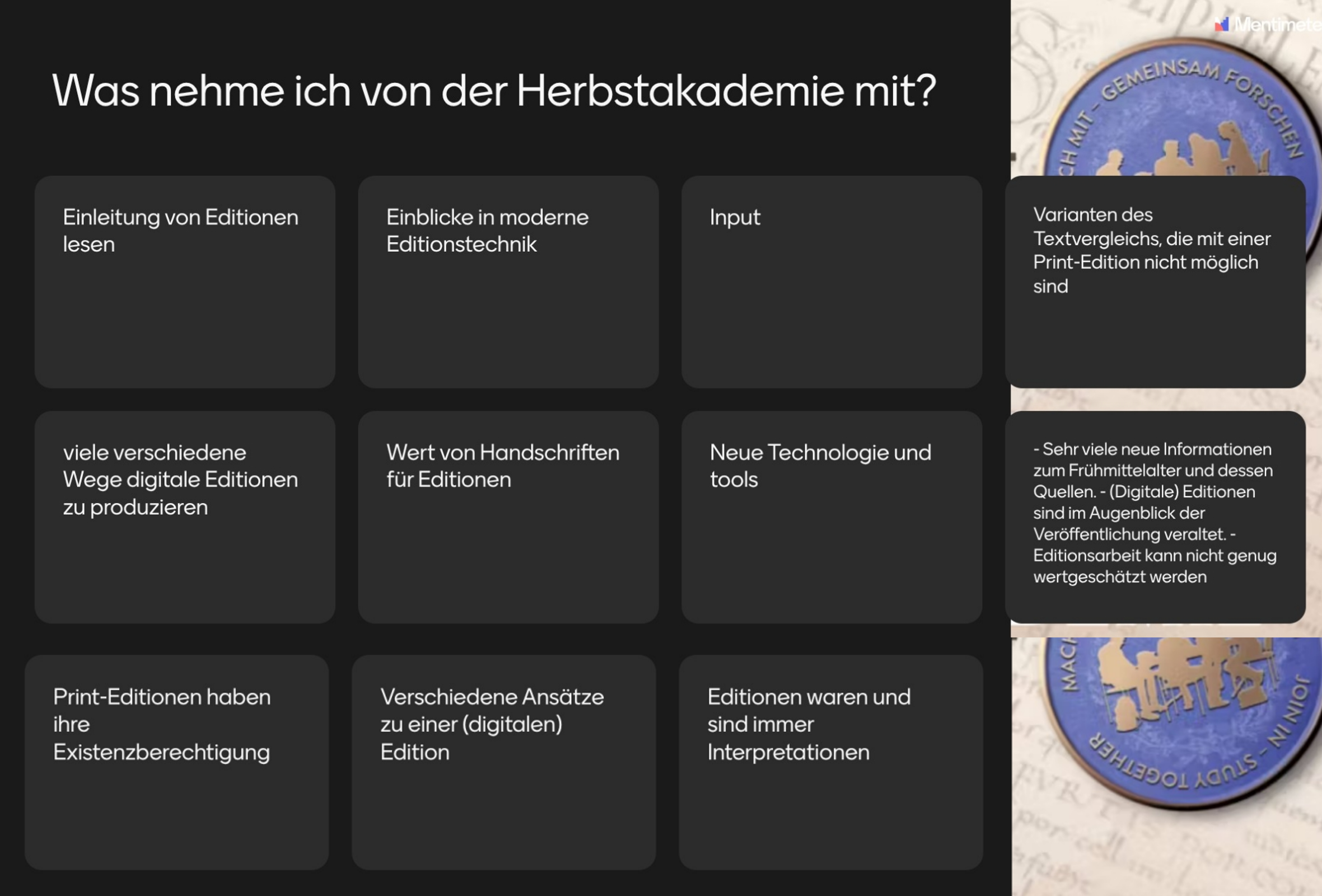
The positive feedback from participants confirmed that combining traditional manuscript studies with modern editing methods and digital tools precisely meets the needs of the current generation of researchers. Particular emphasis was placed on the opportunity to learn about different editing projects and exchange ideas on methodological issues. For the Capitularies Project, the Autumn Academy also offered a welcome opportunity to present its own work and reflect on it in direct exchange with colleagues and young researchers.
The MGH has also published a blog post (in German) about the Autumn Academy, as has the NFDI consortium Text+.